


Is the top of your ash tree looking a bit too thin? You may have seen woodpeckers on the trunk of late where they were not before. Then there is the question of whether an infestation is going on with the ash trees on your property that will not make itself known until you are past the point of no return.
We at Birch Tree Care can tell you from experience what kind of havoc an unobserved Emerald Ash Borer can wreak; we have been in the Twin Cities since 2015 to see it first hand. Should you have any misgivings, give us a ring at (651) 504-6097.
The EAB, as most call this small green beetle, has done considerable damage to ash trees in Minnesota. The adult insect is not hard to overlook. It is the larvae that do the killing over the years by way of their tunneling under the bark. Subtle as the early indications are, a homeowner might not be aware of the trouble his or her trees are in until whole branches start to die off.
But there are things to put one’s eye on. To save a tree instead of having to write it off, it is best to be able to spot them in time.
What the Emerald Ash Borer Gets Up To
An adult will put its eggs on the bark of an ash. The hatching larvae then bore in to feed on the tissue below, the very layer responsible for transporting water and nutrients. In the course of their tunneling the larvae put an end to the tree’s supply of those resources and starve it from within.
Often the infestation has been there a year or more before you see any outward symptoms. Regular inspection is all the more important in our part of the country for that reason.
Things to Watch For
Here are some of the more common signs of an EAB problem:
- A thinning or bare appearance to the upper branches while the rest of the tree is still in leaf, or canopy dieback
- Exit holes of the D variety, about an eighth of an inch across, on the bark after the beetles have made themselves scarce
- S-shaped galleries left just under the bark if you were to remove a piece
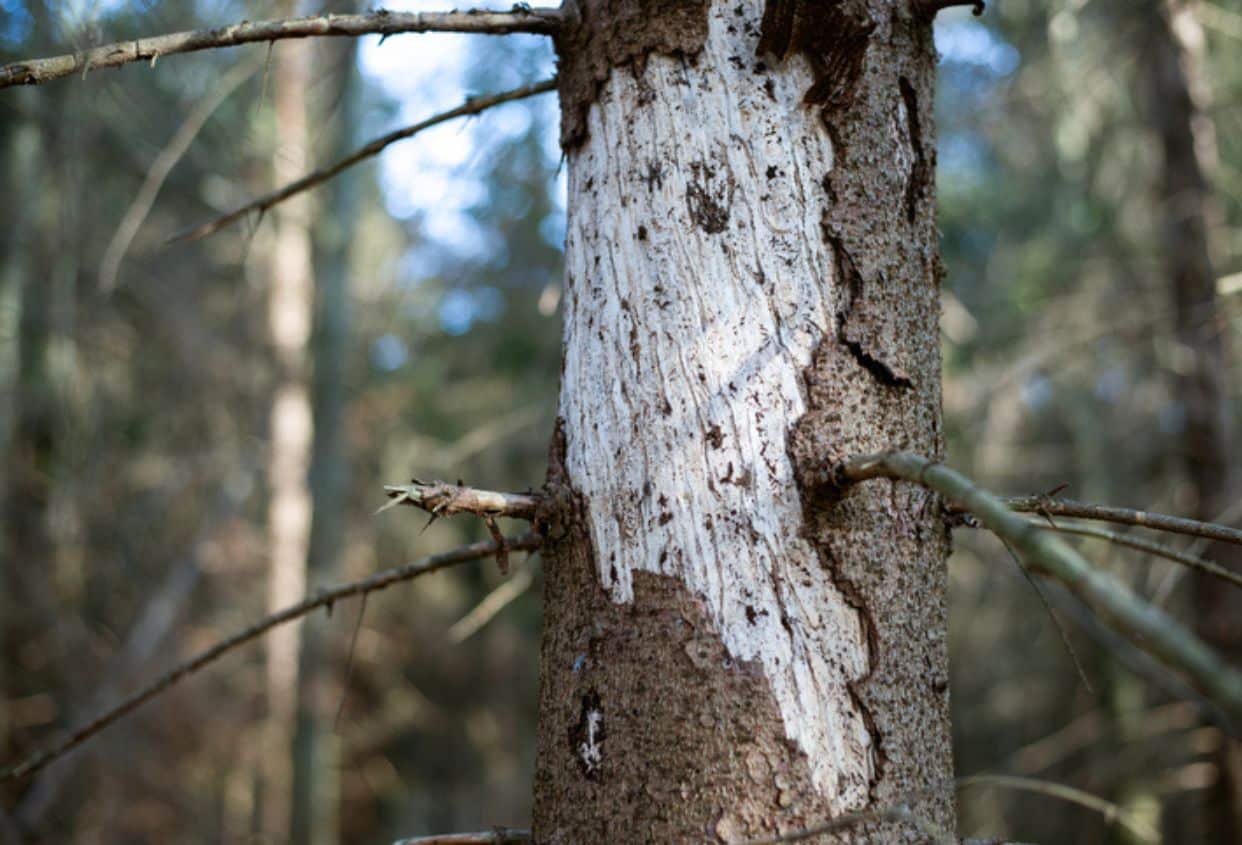
- Woodpeckers in evidence as they strip the bark to get at the larvae
- Epicormic growth, new shoots coming up from the base or trunk in an effort to live on
- The bark cracking or splitting vertically over the tunnels of the larvae
One of these calls for attention, but put two or three together and it is a good indication of EAB.
A Risk for Trees in the Twin Cities
You will find ash in abundance in Anoka, Hennepin, Ramsey and Washington counties as well as Northern Dakota County. Decades back many a neighborhood in Minneapolis, St. Paul, Blaine, Maple Grove, Woodbury and elsewhere was planted with them. With such a density the beetle has little trouble making its way from one place to another.
When a tree is badly infested it is brittle to say the least. There is no telling when a dead ash is going to shed a limb, and that is a safety issue for any home or vehicle in the vicinity.
How to Handle It
An early catch and there are treatments that can be put in place. Our ISA Certified Arborists at Birch Tree Care will put your ash trees through their paces and put forward a plan. We can preserve a good tree with the right plant health care, or if it comes down to it, we will do a safe and responsible removal.
We also do inventory and mapping of trees with GIS for communities and owners so they can make plans in advance. Being part of the local scene is something we take pride in, be it the Fridley Emerald Ash Borer Program or the Watermark Community Tree Planting. We are committed to the protection of the canopy in the Twin Cities.
Licensed and insured, Birch Tree Care is here around the clock for an emergency and we provide Free Inspections.
Let Us Check Your Ash Trees
There are more options available the earlier you are on to an infestation. So if you have seen any of the above, or would like some assurance, the team at Birch Tree Care is ready to help. Call (651) 504-6097 to set up a Free Inspection and let our arborists have a look at your trees while the problems are still small.